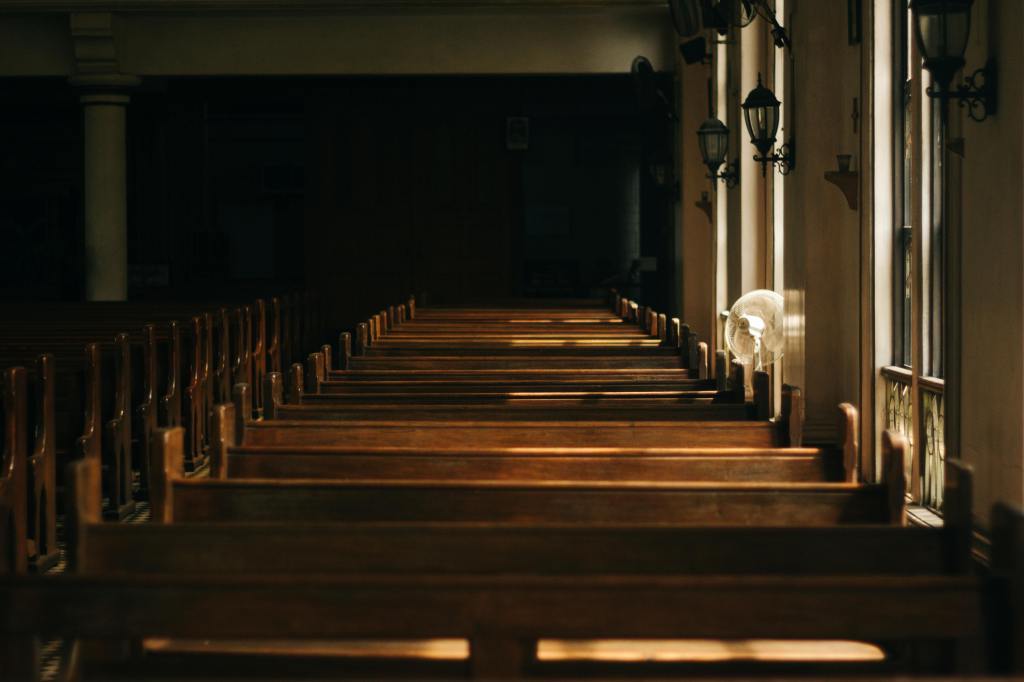
I grew up Catholic. Like many Catholics, my faith has not been consistent over my lifetime—There’s been highs and lows. Most of my life, though, the topic of God and religion has been at the back of my mind. Over the past few years, I’ve been thinking about it a lot more.
I attended St. Clare, a private Catholic school, from first through eighth grade and have fond memories of my time there. I went to church on Sundays, recited the Nicene Creed, and had daily religion classes. I even remember taking a school trip to the seminary in St. Louis and considering joining the priesthood.
During high school, I attended church on occasion and joined a Catholic youth group, but for the most part, religion moved to the back burner.
Later on, while attending the University of Alabama, a friend of mine invited me to a Bible study group and I went to check it out. As we read through some selected verses from Genesis and discussed our thoughts I was intrigued to find out that my fellow engineering students had a very literal view of the Bible.
Growing up as a Catholic, it was my understanding that the New Testament books were literal accounts of Jesus’ life. The Old Testament on the other hand was more of a grey area.
This experience, though, of reading through the Old Testament with Christians who took it as literal fact was eye-opening to me. I realized that I had never dug deep into the historicity of the Bible to find out what I, as a Catholic, am supposed to believe is literal versus symbolic.
One thing I knew for sure though was that the Old Testament conflicts severely with our modern understanding of the world. Sitting in that bible study I realized Christians could be flat out wrong about something. Of course, it wasn’t Catholicism, but it was pretty close. And if one Christian religion could be wrong, could mine be wrong about some things too?
A few years later I was on a bachelor trip in Memphis when we happened to be driving by a church that had a sign out front mentioning the Tower of Babel. After asking my friend to remind me of the story, I recall having a sort of gut reaction that left a bad taste in my mouth.
Let me refresh your memory.
The Tower of Babel, Genesis 11:1-9
11 Now the whole world had one language and a common speech. 2 As people moved eastward, they found a plain in Shinar and settled there.
3 They said to each other, “Come, let’s make bricks and bake them thoroughly.” They used brick instead of stone, and tar for mortar. 4 Then they said, “Come, let us build ourselves a city, with a tower that reaches to the heavens, so that we may make a name for ourselves; otherwise we will be scattered over the face of the whole earth.”
5 But the Lord came down to see the city and the tower the people were building. 6 The Lord said, “If as one people speaking the same language they have begun to do this, then nothing they plan to do will be impossible for them. 7 Come, let us go down and confuse their language so they will not understand each other.”
8 So the Lord scattered them from there over all the earth, and they stopped building the city. 9 That is why it was called Babel—because there the Lord confused the language of the whole world. From there the Lord scattered them over the face of the whole earth.
…Kind of a dick move, right?
The more I thought about that story, the more criticisms I conjured about the character of God.
Now, I’m not so naive as to ignore that this story is meant to be taken as an explanation for diversity in language and division in humanity as a consequence of hubris. But at the same time, this is supposed to be the holy book. My holy book. My divinely inspired holy book. This book should tell me about the nature of my God. How else should I come to know his nature? Let me remove the reverence for a second by telling you the same story in modern terms.
A father comes home from work one day to see his kids building a castle out of LEGOs. The father says to himself “If they build this castle they’ll be empowered to think anything they set out to do is possible. We wouldn’t want that!” So he kicks over their poor LEGOs, turns to his kids, and says “From here on out, you’re no longer allowed to speak to one another.” He then sends them off to boarding schools in different countries for good measure.
Now, what do you think of this father figure?
Again, the proper Catholic reading of this story is that the Tower of Babel symbolizes humanity’s pride or ambition. This ambition, for some unknown reason, is seen as a direct challenge to God’s authority. As a result, all of humanity must suffer the consequences until the end of time (But God loves you!).
As you might have guessed, the Christian understanding of this story just didn’t sit right with me when I looked it up.
Personally, I can’t stand not understanding something. So, I dove headfirst into reading books, watching videos, and developing my own opinions on religion.
I discovered a whole world of arguments both for and against religion that I had never heard of. I read about the problem of evil, biblical contradictions, the fine-tuning argument, divine hiddenness, etc…
This led to even further interest in the realm of philosophy. I learned about determinism, mereological nihilism (does anything actually exist?), subjective morality, and so on.
It’s been two and a half years since the start of this journey. The punchline is that I can no longer call myself a Catholic but I’ve never been more intrigued with religion.
I’ve been reading the Bible lately and I must admit this is the very first time I have ever read the Bible cover to cover. I would guess, though, that 90% of Christians have never actually read the Bible in full. If you are a Christian and you have never read the Bible, I would strongly encourage you to do so. In fact, there’s a free Bible app you can get on your phone right now that works quite well. I would recommend the New International Version (NIV) for readability (Less thee’s and thou shalt’s).
As you read through the Bible I encourage you to challenge your beliefs. Think critically. Take notes. Look up the symbolic interpretations of the challenging stories and ask yourself if those explanations are satisfying to you. If the Bible is truly divinely inspired it should stand up to your challenges.
When you challenge your beliefs there are only two possible outcomes. You either become a better Christian or you realize you never truly believed in Christianity anyway.
At this time I must confess I’m an atheist now, but trust me when I tell you my beliefs (or lack thereof) are not set in stone. If I find sufficient evidence to become a Christian again, I would gladly do so— and I’ll be sure to update this post.
Isn’t it enough to see that a garden is beautiful without having to believe that there are fairies at the bottom of it too?
Douglas Adams
