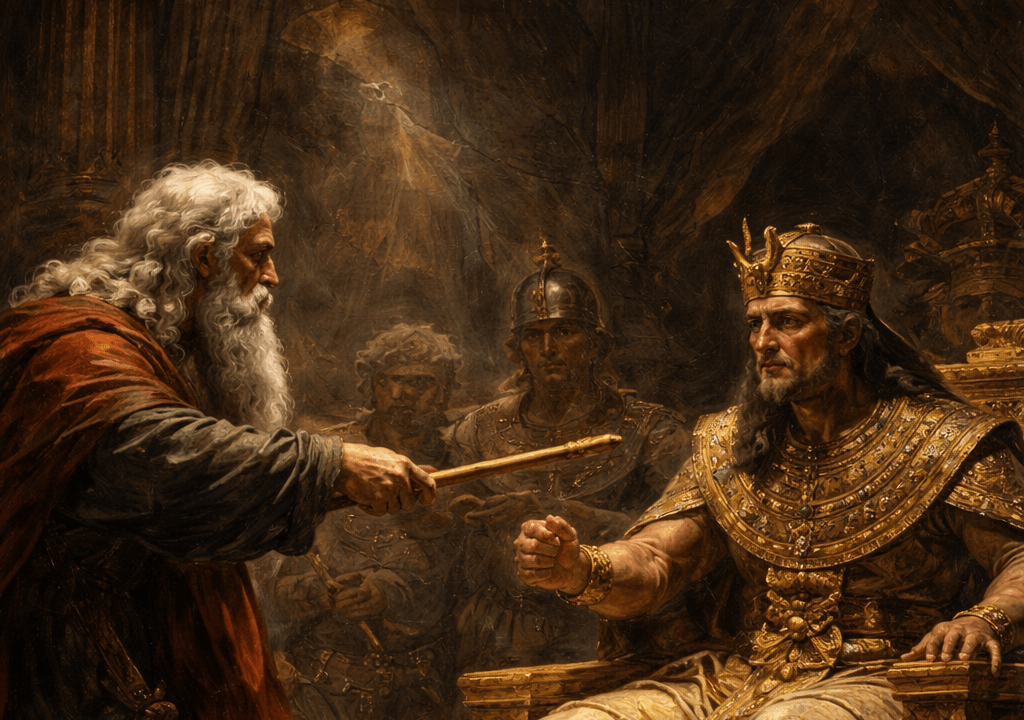
The Hardening of Pharaoh’s Heart and Consequences for Free Will
My first big step to questioning my faith was when I read the book “The God Delusion” by Richard Dawkins. This book gave me concrete reasoning to leave my faith, but another book I’ve been reading has done so much more to convince me of my atheism. That book is the Bible.
I’ve read through Genesis now and have just started Exodus. All I can say is I am truly blown away by the content of these books.
Genesis and Exodus portray an irrational, jealous God who is desperate for believers and weirdly obsessed with male genitalia (If you think that’s an unfair portrayal of God you probably haven’t read the Old Testament). He acts more like some sort of savage, tribal demi-god, promising his would-be followers land, riches, and numerous offspring beyond their wildest dreams in return for blood sacrifices and burnt offerings.
This God does not care for his creation, in fact, he’s quite often seen obliterating it. Strangely enough, he’s also not the only game in town: There are other Gods and even witches and warlocks (just like another popular work of fiction— Harry Potter).
I hope to revisit Genesis another day to pose some significant questions I had, but today I read a passage from Exodus that shocked me in a way I felt compelled to write about:
Exodus 4:21 (NIV)
21 The Lord said to Moses, “When you return to Egypt, see that you perform before Pharaoh all the wonders I have given you the power to do. But I will harden his heart so that he will not let the people go.
For those not up to speed, at this point in the story the Lord’s chosen people, the Israelites, are slaves in Egypt. God commands Moses to ask the Pharaoh of Egypt to set the Israelites free.
(If you grew up Christian, you may recall the children’s song that goes like “Pharaoh, Pharaoh, *clap clap* oh baby let my people go, huh!”)
Here’s where it gets real weird. God then says he plans to harden the Pharaoh’s heart so that he won’t let the Israelites go.
???
What happened to free will? What justification does he have for doing this? More importantly, can God just mind-control people?
There’s so much to unpack here. Let’s start with the smallest problem first: What’s his reasoning for doing this?
Well, to display his power of course!
Exodus 7:3-5 (NIV)
3 But I will harden Pharaoh’s heart, and though I multiply my signs and wonders in Egypt, 4 he will not listen to you. Then I will lay my hand on Egypt and with mighty acts of judgment I will bring out my divisions, my people the Israelites. 5 And the Egyptians will know that I am the Lord when I stretch out my hand against Egypt and bring the Israelites out of it.”
So, in short, our all-powerful God came down on the Egyptians (who are also human beings) with 10 horrific plagues, including killing the innocent firstborn sons of every household, just to demonstrate how powerful he is.
I really struggled with this when I read it. It seems far too obvious that this God obsessed with death, blood, and punishment is in no way compatible with the loving, perfect God I always thought of. How did we get to Christianity as we know it today by starting here?
I mean, if he wanted to free his people, why do it in a way that causes so much undue suffering? There has to be a thousand other harmless ways for an all-powerful God to get the Israelites out of Egypt, but instead we’re given the following description:
Exodus 12:30 (NIV)
30 Pharaoh and all his officials and all the Egyptians got up during the night, and there was loud wailing in Egypt, for there was not a house without someone dead.
Our loving God murdering people aside, let’s move on to the bigger issue. God set up a good portion of these opportunities for displays of power by hardening Pharaoh’s heart.
I have heard this verse before and I knew it was problematic, but after reading the story in full I don’t know why more people haven’t pointed to this as a glaring red flag in the face of supposed free will.
After all, if God is allowed to harden the hearts of whomever he wants at any time, how can we be judged for our actions?
In the case of Pharaoh, God hardened his heart and then punished him for not doing what he wanted. Put yourself in his shoes, if God asked you to do something and then forced you to not abide by his wishes, and then killed your firstborn son because you didn’t follow his request, does that seem fair?
Well, Paul actually has an answer to this in Romans. Let’s see what he has to say.
Romans 9:17-21 (NIV)
17 For Scripture says to Pharaoh: “I raised you up for this very purpose, that I might display my power in you and that my name might be proclaimed in all the earth.” 18 Therefore God has mercy on whom he wants to have mercy, and he hardens whom he wants to harden.
19 One of you will say to me: “Then why does God still blame us? For who is able to resist his will?” 20 Butwho are you, a human being, to talk back to God? “Shall what is formed say to the one who formed it,‘Why did you make me like this?’”21 Does not the potter have the right to make out of the same lump of clay some pottery for special purposes and some for common use?
…Well that’s depressing.
Just to reiterate, Paul is telling us that God can have mercy on whom he wants and harden (and subsequently punish) whom he wants. To add to this, who are we to question him? We are just the clay that he has formed us into, it’s up to him to do with us whatever he wants.
Does this make sense to you?
You’re made by God. Then, if you’re unlucky enough to be someone whose heart God chose to harden, you get to spend the rest of eternity suffering in hell as punishment. But God loves you?
This whole story is sounding pretty bizarre. So far, I’m leaning towards calling it what it is- just an old story. Particularly, an old story that provides no more grounding in reality than a good fiction novel (like Harry Potter).
Granted, maybe this is just a case of the first few chapters of a book being confusing. It may turn out that this seemingly evil God can be salvaged as I read on, in which case I’ll be sure to report back.
Properly read, the Bible is the most potent force for atheism ever conceived.