As I continue reading through the Bible, I keep coming back to the same question—one that grows harder to ignore the further I go:
Why do we still need the Old Testament?
This may sound dismissive, but I mean it sincerely. If Christianity is centered on the life and teachings of Jesus, why not simply take the New Testament as the holy text and leave the rest behind?
Like many people, I grew up mostly ignoring the Old Testament. Its ritual laws, genealogies, and sacrificial instructions were rarely emphasized. When they were, they were treated as symbolic or “no longer applicable.” Instead, we focused on the gentler parts of Scripture—Jesus’s parables, his calls to love enemies, forgive freely, and care for the poor.
So why keep a book that most believers feel the need to explain away?
One answer is suffering.
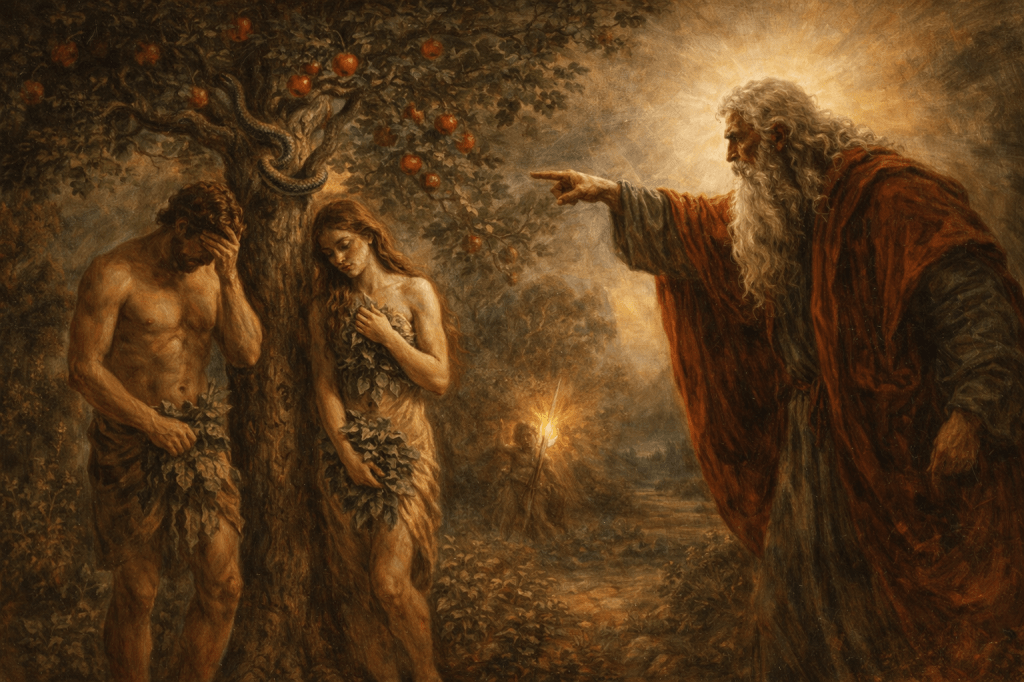
We suffer because of Original Sin. Adam and Eve disobeyed God. Humanity was expelled from the Garden. The rest is history.
Without Adam and Eve, Christianity loses its account of why humans suffer, why we are separated from God, and why salvation is necessary at all.
This explanation is typically presented as settled theology. But the more closely I examine it, the less sense it makes—historically, morally, and logically.
Let’s start at the beginning.
Did This Even Happen?
The first problem with Original Sin is also the most obvious: there is no credible reason to believe the story of Adam and Eve happened as described.
Modern biology leaves no room for two fully formed humans suddenly appearing on Earth, living for hundreds of years, and populating the planet through incest. Evolutionary theory, population genetics, and the fossil record all point in the same direction: humanity emerged gradually, not instantaneously.
Some will object that Genesis was never meant to be read literally, but symbolically. That may be true. However, the doctrine of Original Sin is still treated as the actual explanation for real suffering, real death, and real brokenness in the world. A symbolic story may convey meaning, but it cannot serve as the historical cause of universal human suffering.
And yet, the doctrine of Original Sin is often treated as the consequence of a literal event.
If Adam and Eve never existed, then the foundation of the doctrine collapses immediately.
Still, for the sake of argument, let’s grant that they did exist.
Why Am I Being Punished for Something I Didn’t Do?
Even if Adam and Eve were real people, the doctrine raises a problematic moral question: why are we punished for their actions?
I don’t recall eating forbidden fruit in a garden, yet I am told that my suffering—both large and small—traces back to that act. Not just war, disease, and natural disasters, but even the mundane frustrations of daily life are sometimes framed as consequences of the Fall.
Why should I inherit guilt for something I had no part in?
It’s true that children often suffer because of their parents’ mistakes—but it doesn’t justify infinite punishment for a finite act. Nor does it establish moral guilt in the child.
Others respond by reframing the issue, saying we do not inherit guilt but a “fallen nature” or a state of separation from God. But changing the terminology does not change the outcome. Whether it is called guilt, corruption, or separation, the result is the same: suffering and death imposed on individuals who did not choose the original act.
Justice, as we understand it, requires proportionality.
If I were pulled over for driving 80 in a 75 mph zone, a warning or fine would be reasonable. A life sentence would not be. Neither would punishing my child for the same offense, or his children, and their children, and so on for the rest of eternity.
And yet, this is precisely what Original Sin implies: a universal condition imposed on all humanity forever because of a single act of disobedience committed by two people.
But the deepest problem goes even further.
How Can You Punish Someone Who Didn’t Know Right from Wrong?
According to the story, Adam and Eve did not possess knowledge of good and evil prior to eating from the tree.
Let that sink in.
They had no concept of morality. No understanding of right and wrong. No idea what it meant to should or should not do something.
Now ask yourself this: how can someone be morally guilty without moral awareness?
We intuitively understand this distinction in everyday life. If a three-month-old baby grabs your hair and pulls, you don’t punish them. Why? Because they lack moral agency. They do not yet understand the moral significance of their actions.
Adam and Eve are described in the same position.
God commands them not to eat from the tree—but commands are moral prescriptions. They only make sense if the listener already understands that commands should be followed. Simply issuing a command does not create moral understanding; it presupposes it.
That understanding, however, is precisely what Adam and Eve supposedly lacked.
So what exactly were they expected to do?
Obeying God would require a moral framework they did not yet possess. A framework they could only obtain by eating the fruit. This is a logical circle with no escape.
And yet, when they inevitably do eat the fruit, God responds not with understanding, but with punishment—punishment not only for them, but for every human who would ever exist.
What Kind of Father Does This Describe?
Christians often describe God as a loving father. But if we take the story at face value, that analogy raises an uncomfortable question: what would we call a human parent who behaved this way?
Imagine a father who gives his young children a rule they cannot fully understand. He withholds from them the very knowledge required to obey that rule, then punishes them severely—not only them, but all of their future children as well—for failing to meet an impossible standard.
We would not call this love. We would call it abuse.
“I locked my kids in a room with a loaded gun, but I told them not to touch it so they should be fine…”
-An Incredibly Stupid Parent
In any other context, deliberately setting a child up to fail and then inflicting punishment would be morally inexcusable.
And yet, when this same dynamic appears in the doctrine of Original Sin, it is called justice. For some reason, Adam and Eve’s lack of moral awareness becomes irrelevant. Their punishment is deserved. The guilt shifts entirely onto the child.
If God is truly a perfect father, then the standards we apply to human parents should not suddenly collapse when we apply them upward. If anything, we should expect more mercy, not less.
The Reasonable Conclusion
Taken seriously, the doctrine of Original Sin depends on a story that is historically implausible, morally disproportionate, and logically incoherent.
It portrays humans as guilty before they understand guilt, punished before they understand morality, and condemned for actions they could not meaningfully avoid. And it presents a God who responds to this inevitability not with mercy, but with collective and infinite punishment.
Perhaps the story is merely symbolic. Perhaps it was never meant to be read literally. But if that’s the case, then it fails as an explanation for real suffering—and Christianity loses its primary answer to the problem of evil.
Graduating from Guilt
In my opinion, we are not “born into sin”. We are not inherently evil from the moment we take our first breath. We are not cursed by a prehistoric moral failure.
We should not carry around this guilt for a crime that never happened.
Furthermore we shouldn’t pass on that guilt to our children.
A far more honest explanation is also a simpler one: the universe is not malevolent—it is indifferent.
Physics operates uniformly. Plate tectonics cause earthquakes. Viruses replicate. Stars explode. Evolution optimizes for survival and reproduction, not fairness or happiness. Suffering arises not because humanity is morally fallen, but because the universe does not care about human well-being.
To be clear, this is not a failure of a naturalistic worldview. It is exactly what we should expect if there is no intentional designer optimizing outcomes and no moral governor overseeing reality. Indifference explains randomness, unfairness, and excess suffering without requiring us to excuse it or redefine harm.
In a naturalistic universe, suffering is tragic—but it is not moral punishment. There is no inherited guilt to atone for, only harm to reduce and responsibility to take in the present.
Seen this way, the story of Adam and Eve reads not as history, but as a mythic attempt to explain suffering in a pre-scientific world—one that ultimately creates more moral problems than it solves.
Questions from The Margins
I recently bought a beautiful physical copy of the Bible that has ample room in the margins to journal and make notes. I went back to the beginning and wrote down questions that popped into my head as I was reading through it. The list below contains the collection of questions I had on my re-reading of Adam and Eve. I don’t have answers for these, but I do feel that some of the questions might give you something to chew on, or a good chuckle.
Why does the tree even exist?
Why not put the flaming cherubim in front of the tree in the first place to make sure Adam and Eve don’t eat it?
Why make it a tree that has fruit which is “pleasing to the eye”?
Why put the tree in the Garden?
Why not make it a smelly old sock in a muddy swamp on the other side of the universe?
These are not “gotchas.” They are only an example of the kinds of questions that come up when the story is read carefully rather than reverently.